Why is A.D 70 Important?
Since “Moses and all the Prophets” point to the first century coming of Christ Luke 24:27, we know the very “fulness of the time had come” Galatians 4:4.
This ample revelation in the Old Testament word prepares us for the abundant redemption in the New Testament world. All Christians are well aware of the unparalleled redemptive-historical significance of the incarnation, crucifixion, resurrection, and ascension of Christ.
We are equally well apprised of His victorious pouring out of the Holy Spirit upon the Church in A.D. 30. But too few realize the significance of the
pouring out of His holy wrath upon Jerusalem in A.D. 70.
Yet the A.D. 70 events loom large in New Testament prophecy, serving as a dramatic consequence of the first advent. The A.D. 70 event flares up at
us in several prophecies in Luke’s gospel alone: Luke 13:32-35; 19:4144; 21:20-24; and Luke 23:28-31.
Furthermore, it is not only the subject of many of the Lord’s parables e.g., Matthew 21:33-45; 22:1-14 but even causes the Lord’s tearful lament over Jerusalem Matthew 23:38. And that lament introduces one of His longest recorded discourses, a discourse initially focusing upon that woeful year Matthew Chapters 24-25.
Let us consider the significance of A.D. 70 in just four areas.
A.D. 70 Corroborates the Messiah’s Authority
The A.D. 70 catastrophe results from Christ’s prophetic word, corroborating His Messianic authority in a dramatic way. Not only does A.D. 70 prove his prophecy to be a true word from God Deuteronomy 18:22 but a judgment word against God’s people.
The disciples’ request for a “sign” marking out “the end of the age” Matthew 24:3 sparks the Olivet Discourse in Matthew 24:24-25. Up through Matthew 24:34.
Jesus focuses on Jerusalem’s destruction: the devastation of the holy city and conflagration of its holy house become “the sign of the Son of man in heaven” Matthew 24:30. That is, when the first century holocaust explodes upon Israel, it definitively signifies the divine authority of the One now in heaven Matthew 26:59-64; Luke 23:20-31.
Too many Christians miss the meaning of Jesus’ cloud-coming in Matthew 24:30 for two reasons:
(1) Unfamiliarity with Old Testament apocalyptic language, wherein divine judgments appear as cloud-comings e.g., Isaiah 19:1.
(2) Oversight of Matthew 24 interpretive clues: mention of the Temple’s destruction Matthew 24:2, the Judaean focus Matthew 24:16, and the temporal proximity of all the events between verses 4 and 34 Matthew 24:34.
Indeed, Jesus warned the very men who sat in judgment over Him: Matthew 26:64.
A.D. 70 Concludes the Old Covenant Economy
The Old Testament was replete with signs and symbols foreshadowing the work of Christ. The very nature of that typological era demands that it was a temporary step toward the full redemptive-historical conclusion brought about by Christ, a passing stage moving toward a grand climax.
Indeed, the New Covenant vitality could not be contained within the Old Covenant strictures of a racial people, geographical land, and typological Temple, for you cannot “put new wine into old wineskins, or else the wineskins break, the wine is spilled” Matthew 9:17.
The New Testament frequently indicates this looming change of covenantal administration. For instance declares: Hebrews 8:13
Indeed, Hebrews warns Jewish converts not to slip back into Judaism, especially as they see “the day [A.D. 70] drawing near” Hebrews 10:25.
Such apostasy would return them to a material and soon-to-vanish copy of the true, for Christ has brought God’s people to “the greater and more perfect tabernacle not made with hands” Hebrews 9:11; 9:24.
The spiritual New Covenant is not linked to a physical Temple, consequently it “cannot be shaken” and overthrown Hebrews 12:28.
A.D. 70 Confirms the Gentile Ministry
In the Old Testament God’s people were virtually co-extensive with the Jewish race Amos 3:2.
But all of this changes at the resurrection whereupon Christ commissions His disciples “to make disciples of all the nations” Matthew 28:19; Acts 1:8.
Unfortunately, the early church was tempted to rest content in the Jewish mission (witness Peter’s experience in Acts 10-11). With the growing ministry of Paul this begins to change; in the approaching demise of the Temple such a temptation will be forever cured. This remarkable shift of focus from a Palestinian Jewish mission to a world-wide Gentile mission is finally sealed in A.D. 70.
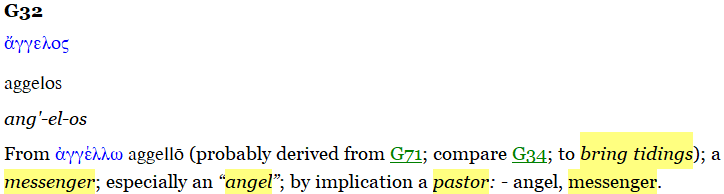
Returning to Matthew 24 we learn that consequent upon the Temple’s overthrow, Christ will send His “messengers” (Greek angelos, here they are human messengers) “with a great sound of a trumpet, and they will gather together His elect from the four winds” Matthew 24:31.
Thus, at Jerusalem’s fall the final Jubilee see Leviticus 25 — eternal salvation — will be declared to all the world. Now that the Old Covenant constraints are forever removed, the world becomes the mission field for the Church.
Indeed, Paul prophetically relates the ultimate success of the Gentile mission to Israel’s “fall,” i.e., her stumbling over Christ and consequent A.D. 70 destruction. For her “fall is riches for the world,” her “failure riches for the Gentiles” Romans 11:12. Indeed, her “being cast away is the reconciling of the world” Romans 11:15.
A.D. 70 Confronts with the Divine Severity
A.D. 70 emphasizes the reality not only of God’s goodness but His severity. Paul warns those who would call themselves God’s people: Romans 11:22
The “severity” that befalls the Jews in A.D. 70 exhibits God’s judgment upon their unbelief and rebellion. Melito of Sardis speaks thus of the Jews: “thou smotest thy Lord: thou also hast been smitten upon the earth. And thou indeed liest dead; but He is risen from the place of the dead.”
Though Israel had a glorious heritage Romans 9:3-5, though her “root is holy” Romans 11:16 she tragically illustrates the consequences of failing a holy responsibility. We must all learn the lesson therein exhibited, “for everyone to whom much is given, from him much will be required” Luke 12:48. Israel’s judgment in A.D. 70 underscores the awesome obligation resulting from the divine calling.
But as Israel withers under the scorching heat of God’s severe wrath, the Gentiles will flourish in the cool waters of God’s good mercy Romans 11:12, 15; Acts 13:46-47. Such is the goodness of God. Nevertheless, the Gentiles, too, must take the lesson to heart, “for if God did not spare the natural branches, He may not spare you either” Romans 11:21.
This Jewish-judgment/Gentile-blessing interplay is prophesied by Christ.
Speaking of the kingdom He is establishing; the Lord alludes to A.D. 70: Matthew 8:11-12
Conclusion
The spectre of A.D. 70 haunts the New Testament record (being frequently and vigorously prophesied); its occurrence dramatically impacts first century history (being one of its more datable and catastrophic events).
Jerusalem’s destruction confirms important redemptive-historical truths:
Christ’s supreme authority,
the Old Covenant economy’s termination,
the gospel’s world encompassing nature, and Israel’s judgment and
imparts significant practical lessons to us (our high calling involves holy obligations).