The Generations of Jesus and the Number Forty
Of all the types and shadows of the Old Testament in the Bible, none are as pervasive and important as the number forty as it relates to the fulfilment of God’s promises.
In the Old Testament, the number forty is found 32 times. Most of these refer to a forty-year period. In the New Testament, it is found 6 times.
Here are some Old Testament examples:
Forty days and nights of rain in Noah’s day. Genesis 7:12
Issac was 40 years old when he married Rebekah. Genesis 25:20
Esau was 40 years old when he married Judith. Genesis 26:34
Saul reigned for 40 years. Acts 13:21
David reigned for 40 years. 1 Kings 2:11
Solomon reigned for 40 years. 1 Kings 11:42
Moses was up on Mt. Sinai for 40 days receiving the Law. Exodus 24:12,15,18
Eli served as High Priest for 40 years. 1 Samuel 4:18
Jonah preached to Nineveh for 40 days. Jonah 3:4
Jesus fasted for 40 days and 40 nights. Matthew 4:2
The most significant of the number forty-year type and shadow time periods in the Old Testament was the first forty-year wandering in the wilderness to a temporal land of promise. 1 Corinthians 10:6, 11
The second forty-year generation from the Cross, AD 30, to the Return of Jesus, AD 70, marked the entrance into the Eternal Heavenly Land of Rest.
Let’s examine and compare these two forty-year periods.
In the Old Testament, the Nation of Israel was in physical bondage in Egypt before the exodus. Preceding the forty-year generation from the Cross to the year AD 70, Israel was in spiritual slavery to sin and death.
The first forty-year period introduced the first Passover which was the blood of lambs applied to the doorpost. Exodus 12:3,7,22,23
The second forty-year period introduced the Passover of the Lamb of God, Jesus. John 1:29
One brought physical deliverance through the Red Sea; the other brought deliverance through Water Baptism in the Name of Jesus Christ. Acts 2:38-39
Just as it was in the wilderness, the children of faith were allowed to enter the temporal land of rest and promise; the children of faith in the generation directly following the Cross also were given entrance into the Eternal Land of Rest in the year AD 70. With each Covenant, Old and New, a forty-year transition period followed the initial act of deliverance into the Land of Promise.
Under Moses, daily Manna, meat, the cloud, and fire revealed God’s power and presence. In the transition period to the New Covenant, the Apostles had special gifts and power for signs and wonders.
They testified to the coming again of Jesus in AD 70 and the consummation of God’s Kingdom and the Judgment of the wicked. Mark 16:20, Hebrews 2:4 During both of these forty-year periods, the wicked were severed from among the just and not allowed to enter the Land of Promise. Hebrews 3:11, 17, Matthew 13:49.
The forty-year wandering in the wilderness was a type and shadow of the early first century Christians being tested to see if they would be faithful enough to enter this Heavenly Promised Land. 2 Peter 1:10-11
During this forty-year period, the Kingdom existed in a temporary state and was about to inherit its Eternal state. God makes reference to the unbelieving generation in the wilderness. Psalms 95:10
The Tabernacle in the Wilderness was a type and shadow of the born-again new birth experience.
Here are the comparisons:
Only One Door – John. 10:9
One Temple – 1 Corinthians 6:19
Only One Plan of Redemption – John 3:3,5,7
Only the priest who had God’s calling could minister. Romans 10:15, John 3:34, 2 Timothy 2:6
The second forty-year journey that began in AD 30 and ended in AD 70 was to the Land that Abraham looked for by faith. Hebrews 11:8-10,13-16,39-40, 12:22-23, 27-28, Revelation 21:1-4, 25-27
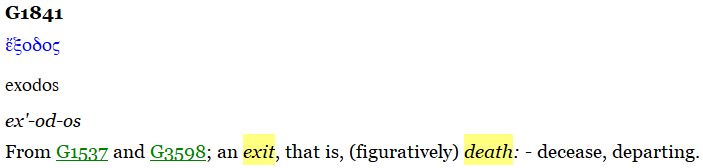
In Luke 9:31, the Scripture speaks of the beginning of the Second Exodus that began at Calvary with the Blood of Jesus, the Lamb of God. In verse 31, the word “decease” in the Greek means to exit, to depart, or exodus. Strong’s G#1841
Forty years after Calvary, they entered the Eternal Promise Land. Jesus said that it was in His generation that the Judgment of God came. Matthew 24:3,27, 29-31, 34, 25:32-33,46
Types and shadows were figures of speech used by Moses and the Prophets that would be fulfilled by Jesus, His Apostles and the First Century Christians.
This fulfilment took place in what the Bible calls the Last Days. Luke 21:22 The forty-year period of time from AD 30- AD 70 was the last generation of the Old Covenant relationship that God had with the twelve tribes of Israel.
Events surrounding the Last Days are the central focal point of the entire Bible. The theme of the Bible is about the fulfilment of all of God’s Promises. Romans 15:8
The Eternal things that Adam and Eve lost for mankind through sin would be regained through obedience to the Gospel of Jesus Christ. 1 John 5:11
The Last Days are past events that happened almost 2,000 years ago.
They are not future events.
The Apostle Peter wrote about the Last Days 2,000 years ago. Acts 2:17, 1 Peter 1:20 Jesus provides Eternal Redemption, Eternal Life, the Eternal Day, and Eternal Glory through the Gospel. 1 Peter 5:10, 1 John 5:13
Conclusion
Our study today on the significance of the number forty used throughout Scripture is another undeniable proof that Jesus returned in AD 70. The Futurist view that Jesus has still not returned after nearly 2,000 years is a clear departure from the timetable established throughout the Bible.
It was THAT generation that saw the fulfilment of ALL things that were written. This fulfilment took place within that forty-year time period of AD 30- AD 70. Luke 21:22, 27,31-32
We are in the Eternal Day today. We are in God’s Kingdom right NOW. The fact that the Last Days already happened proves that the New Covenant is here right now and is Everlasting.
The New Covenant has no end. Ezekiel 37:26, Jeremiah 32:40
We are in that Eternal Day. John 11:25-26 Jesus is NOT coming back again someday in the future to end the very thing that for which He died to establish.