
Word Study of the Greek Word “eggus”
(Near, Nigh, at Hand or Ready)
Today, as we seek once again to gain more clarity in our understanding of the Scriptures, we will be taking a closer look at the meaning of Greek word “eggus” Strongs G#1451 and it’s use in the Bible. The Greek word, “eggus” is an adverb.
An adverb is a part of speech that answers when, where, how, why, or how much.
An adverb can modify verbs, adjectives, or other adverbs. The Greek word, “eggus” is used approximately 30 times in the New Testament.
When “eggus” is used relating to distance, it is translated into English as “nigh” or “near”.
In Luke 19:11, we have an example of this usage. “…. because he was near (‘eggus’) to Jerusalem…..”
In John 3:23, we find another example of “eggus” used in this same context. “And John also was baptizing in Aenon near (‘eggus’) Salim…”
John 6:19 is the account of Jesus walking on the water and “drawing near (‘eggus’) the boat….”
John 11:18 says “Now Bethany was nigh (‘eggus’) unto Jerusalem, about 15 furlongs off:”
In John 11:54, the word “eggus” is translated as “near”.
One more example of “eggus” used in this way is Acts 9:38; “…Lydda was near (‘eggus’) Joppa….”
In all these examples, we can clearly see that the Greek word “eggus” is translated as “near” or as it is rendered in the King James Version “nigh” when used to denote proximity or distance.
The Greek word “eggus” is also used in expressions of time. When used in time expressions, “eggus” is used to denote things that are:
imminent
soon to come to pass
or things at hand.
Now let’s look at some of these usages of “eggus”. In John 2:13, we read about the Jews’ Passover was at hand, “eggus”. This use of “eggus” denotes that the Passover was very near in time.
Again, in John 6:4, the Passover, a feast of the Jews, was near (eggus); it wasn’t very far off at all.
In John 7:2, we read about another feast of the Jews’ which was at hand, “eggus”.
All these events were shortly to take place. That’s why the Greek word “eggus” was used.
In John 11:55, we read about the Jews’ Passover; it was nigh at hand (“eggus”). When “at hand” was added to “nigh”, this stressed the nearness of an event even more.
We read in Matthews 26:18 Jesus states that His time is “at hand”. (“eggus) Of course, He was referring to His crucifixion which was very close to taking place. This is why the Greek word “eggus” is used.
Another Biblical use of the Greek word “eggus” was to express a place, position, or state. For example, in Ephesians 2:13; “eggus” is used to describe what the Gospel message did for the Gentiles. (Remember, “Gentile” simply means “not Jewish”)
The blood of Jesus brought the Gentiles, who used to be far off, “nigh” or “eggus” to the Kingdom of God. We see a similar use of “eggus” in Ephesians 2:17.

Here we read how this Gospel was preached to both the Jews, who were “near” through the Old Covenant, and to the Gentiles. Up to this point, the Gentiles were referred to as aliens from the commonwealth of Israel, and strangers from the covenants of promise, having no hope, and without God in the world. (Ephesians 2:12)
It is the Gospel message that brought them “nigh/near” (“eggus”) to the Kingdom of God.
Paul tells how the Lord revealed onto him a great mystery which is the Gentiles have opportunity to become fellow-heirs and partakers of His promise in Christ by the Gospel. (Ephesians 3:3-6) Now, there is no Jew nor Gentile. (Galatians 3:28)
In Hebrews 8:13, we see the word “eggus” translated as “ready”.


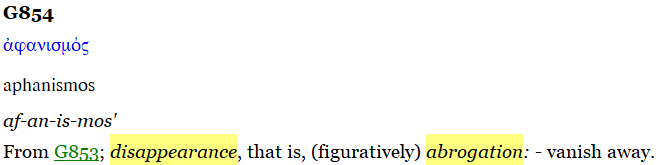
Such an important time statement is used here signifying that the passing of the Old Covenant is very near and the establishment of the New Covenant is very soon to take place.
This is what Jesus said that He came to do; fulfill the Law and the Prophets and usher in the New Everlasting Covenant. (Matthew 5:17, Romans 10:4, Isaiah 55:3) The nearness of this event is denoted by the word “eggus”.
In Philippians 4:5, we read “The Lord is at hand, (‘eggus’).”

The Thayer Greek Lexicon p. 164 says that this use of “eggus” denotes the near advent or coming of the Lord, the nearness of Christ’s return from heaven.
The Greek New Testament also cross references this Philippians 4:5 with Hebrews 10:37 and James 5:8-9.
This is a huge time statement by the Apostle Paul. Now let’s read how the Living Translation of the Bible translates Philippines 4:5: “Let everyone see that you are considerate in all you do. Remember, the Lord is coming soon.” It was translated like this because this is exactly what the Greek word “eggus” is relating to us. This is exactly what “at hand” means.
Now, let’s read some of the words of Jesus as He used many time statements relating to His Return. In Matthew 24:32-33, we read how Jesus used the parable of the fig tree to make a strong time statement. He said, “…. when his branch is yet tender, and putteth forth leaves, ye know that summer is nigh, (‘eggus’). So likewise, ye, when ye shall see all these things, know that it is near (‘eggus’), even at the doors.” Jesus just spent the whole chapter 24 of Matthew relating to His disciples the timing of the “end time” events.
The “end time” that Jesus was speaking about was the end of the Old Covenant. In the detailed list of the signs to look for, Jesus included the:
the abomination of desolation,
the great tribulation,
the sun and moon being darkened,
the heavens being shaken,
and his coming in the clouds with a great sound of a trumpet.
Jesus gives this parable of the fig tree at the end of this list of signs to look for. The Greek word “eggus” is used here to emphasize the nearness of all these events.
Jesus even says adds the phrase “at the doors” to “nigh” to add even greater imminence to all these “end time” events.
Jesus tops all of this off with proclaiming that “…. this generation shall not pass, till all these things be fulfilled.” (Matthew 24:34)
The exact same parable of the fig tree is found also in Mark 13:28-30 and in Luke 21:30-32. Once again, the Greek word “eggus” is combined with “at the doors” and “at hand” to record this same strong time statement made by Jesus.
What about the Apostle John? Was the Greek word “eggus” used in any of his writings? The answer is “Yes!”
In Revelation 1:3, we read: “….for the time is at hand (‘eggus’).”

This all-important time statement at the beginning of the Book of Revelation tells us that the time was imminent.
The Apostle John was saying that all of the events that he had recorded in the Book of Revelation were soon to come to pass (“eggus”) In Revelation 22:10, John was instructed to NOT seal the sayings of the prophecy of this book: for the time is at hand (“eggus”) This is in direct contrast to the prophet Daniel who received visions of “end-time events” Daniel was told to seal the book until the time of the end. (Daniel 12:4,9) Daniel received these visions 6th century BC some 750 years prior to the fulfillment of his vision of these “end-time” events.

This means that 750 years was considered to be a LONG time away. At the end of the Book of Revelation, John was told NOT to seal up the prophecy of this book, for the time was at hand (“eggus”) If the whole Book of Revelation hasn’t taken place yet, some 2,000 years later and counting, why was John told NOT to seal the Book?
Conclusion
We see through the examples that we have cited in this lesson, that the Greek word “eggus” was always used to express a nearness of a location or of an event.
“Eggus” is a definite time statement that was used over and over again to denote imminence. Many try to twist this Greek word to mean something other than what the grammar and the context in which it is used denotes.
It always means imminence, the nearness of an event getting ready to take place very soon. The nearness was to them, the first-century audience to whom all these things were spoken and written, not to us today.
Today, we have Good News for everyone that has ears to hear: the Kingdom of God is right here, right now. Salvation can be yours today if you believe and obey this wonderful Gospel message. (Acts 2:37-39)
You too can come and take the water of life freely. (Revelation 22:17) You too can live forever! In the eyes of God, there are only two types of people in our world today, believers and unbelievers. Which one will you choose to be today.












