"Behold, I come quickly"
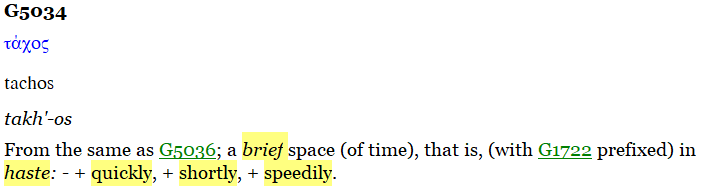
Word Study on the Greek Word “tachos”
The New Testament was originally written in “Koine Greek”. The Koine Greek is a very specific language that can give us further insight into the meanings of words and phrases used throughout the New Testament.
A study of a particular word in the Koine Greek can establish patterns for a more complete understanding of statements of Truth we read about in the New Testament. Today, we are going to be examining the Greek word “tachos” and its many uses throughout the New Testament.
The word “tachos” and all the different related forms of this Greek word is used over 30 times in the Greek New Testament.
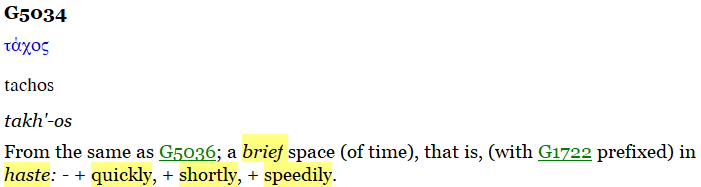
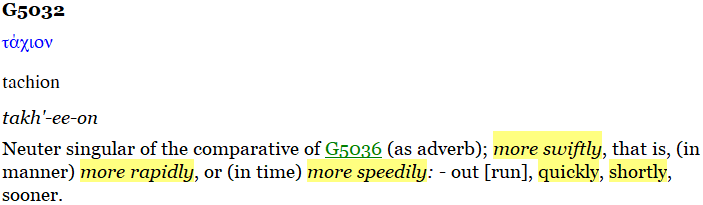
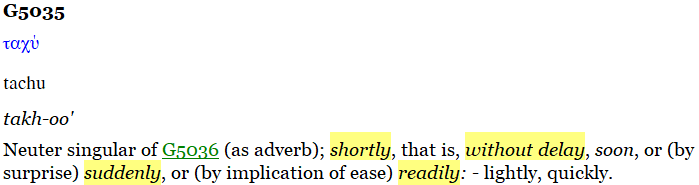
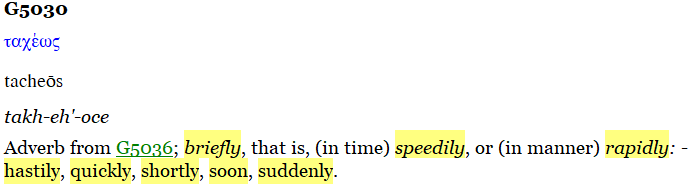
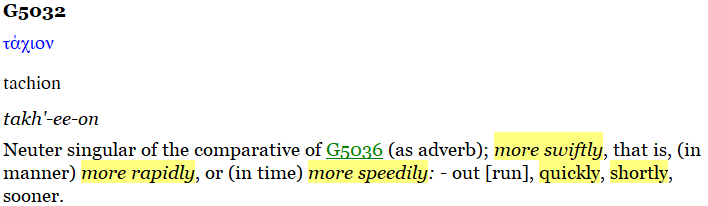
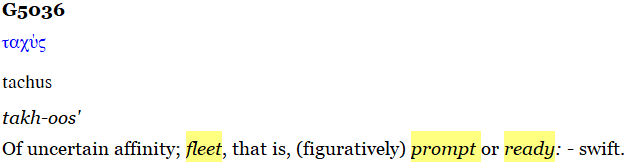
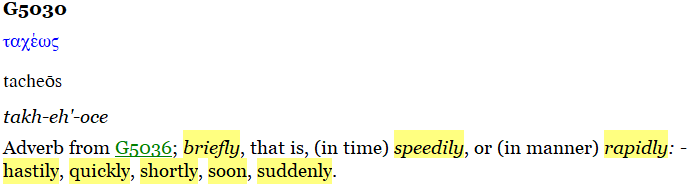
It’s meaning is: “briefly” in time, “speedily” in manner, “rapidly”, “hastily”, “quickly”, “shortly”, “soon”. It clearly denotes something that is “shortly” going to take place with emphasis on “no delay” if any at all. When the writers wanted to express imminency of any event or happening, a form of “tachos” was one of the Greek words that was often used.
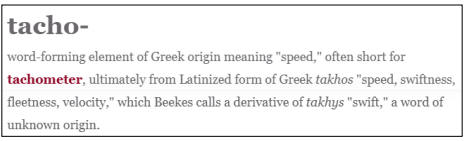
We derive our English word, “tachometer” from this Greek word. A tachometer is an instrument that measures the rotation speed of a shaft or disk in an engine.
In order to get a consistent application of the meaning and use of this Greek word, “tachos”, we must look at several verses in which this word was used.
Let’s begin in Acts 12:7
Here the angel told Peter to rise up quickly (tachos). Peter didn’t waste any time when the angel told him this.
In Acts 22:17-18, Paul is giving his testimony to an angry Jewish mob in Jerusalem. He related that while he was praying, he fell into a trance and saw Jesus telling him to “Make haste and get thee quickly (tachos) out of Jerusalem….” Already we can see that “tachos” is used to communicate urgency.
In 1 Timothy 3:14, Paul is communicating with Timothy that he will be coming to see him “shortly” (tachos). It clearly was saying that it would just be in a little while.
In Matthew 5:23-25, Jesus is teaching a concept associated with giving; “Agree with thine adversary ‘quickly’ (tachos) …”
In Matthew 28:7, the angel told the women at the empty sepulcher of Jesus to “….go ‘quickly’ (tachos) and tell His disciples that He is risen from the dead….”
Those women went both speedily and quickly. In this same setting in Mark 16:8, “And they went out ‘quickly’ (tachos) and fled from the sepulcher”.
The word “tachos” is also used in the Greek in Luke 15:22 in the parable of the prodigal son. This scripture is unique because the word “tachos” is not translated into the English but is rather “understood”.
It should read, “…. quickly (tachos) bring forth the best robe….”
In John 11:29, we find Mary’s reaction to the arrival of Jesus soon after the death of Lazarus; “As soon as she heard that, she arose ‘quickly’ (tachos) and came unto Him.”
Also, in John 11:31, Mary “…. rose up ‘hastily’ (tachos) and went out….” to weep at the grave of Lazarus.
Jesus told the parable of the great supper in Luke 14:21; “…. Go out ‘quickly’ (tachos) into the streets and lanes of the city…..”
Another parable in Luke 16:6: “…. take thy bill and sit down ‘quickly’ (tachos) and write fifty.”
In 1 Corinthians 4:19, Paul says “But I will come to you ‘shortly’ (tachos)” speaking about a soon visit he would be making.
This same context is found in Philippians 2:19, 24. Paul says, “But I trust in the Lord Jesus to send Timotheus ‘shortly’ (tachos) unto you….” “But I trust in the Lord that I myself shall come ‘shortly’ (tachos)”
Also in 2 Timothy 4:9, Paul says, “Do thy diligence to come ‘shortly’ (tachos) unto me.”
At the Last Supper, Jesus told Judas in John 13:27, “…. That thou doest, do ‘quickly’ (tachos)”.
In James 1:19, “tachos” is translated as “swift”.
In Galatians 1:6, Paul says, “I marvel that ye are so ‘soon’ (tachos) removed from him that called you….”
In Romans 16:20, we can see that Satan’s defeat is coming very “shortly” (tachos).
In all of these examples that we have cited so far, no one would have any difficulty at all understanding the use of the word “tachos”.
We can see time and time again that this Greek word denotes something that is happening very shortly, quickly, swiftly, and without delay.
There is no debate about what “tachos” means in all of the above passages.
Now that we have clearly established the meaning in several Scriptural examples, let us continue to examine this same word in many other Scriptural references.
In Revelation 1:1, “….to shew unto his servant’s things which must ‘shortly’ (tachos) come to pass….”
John, in the very first verse of the Book of Revelation, makes a very strong time statement. He said that everything recorded in the Book of Revelation was going to “shortly” come to pass.
This is the same John who was in the Spirit on the Lord’s Day and was told by Jesus to write down EVERYTHING he saw. (Revelation 1:10,17-19)
If anyone knew about the timing of these events in Revelation, it would be the one who saw it and experienced it, the Apostle John. Let’s continue to travel through the Book of Revelation and notice all the uses of the word “tachos”
In Revelation 2:5, Jesus says, “…. or else I will come unto thee ‘quickly’ (tachos)…”
Jesus proclaims in Revelation 3:11, “Behold, I come ‘quickly’ (tachos)….”
In Revelation 22:6, “…the Lord God…. sent his angel to shew unto his servants the things which must ‘shortly’ (tachos) be done.”
Revelation 22:7, “Behold, I come ‘quickly’ (tachos)….”
Revelation 22:12, “And, behold, I come ‘quickly’ (tachos)”
Revelation 22:20 says, “…. Surely, I come ‘quickly’ (tachos)….”
So, we can clearly see, the Book of Revelation begins with a very clear time statement of immanency and closes with this same predominant time statement.
When we get to the Book of Revelation, the Greek word “tachos” does not, all of a sudden, take on a different meaning.
“Tachos” still means briefly in time, speedily in manner, rapidly, hastily, quickly, shortly, and soon. This is the exact same way that this Greek word is used throughout the Scriptures. We can see this over and over again clearly through all of the examples cited in this study.
Conclusion
When it comes time to see the meaning of this same word, “tachos” being used by Jesus to proclaim His coming “quickly” (tachos), many try to twist the meaning here to agree with their theology.
If our theology doesn’t agree with the Scriptures and what Jesus said, is it high time to adjust our theology so we can be in total agreement with the Word of God.
To believe something other than what the Word of God is clearly telling us, is to believe another Gospel. It is our responsibility to STUDY to show ourselves approved unto God, a workman that needeth not to be ashamed, rightly dividing the Word of Truth. (2 Timothy 2:15)
TIME TO GET TO STUDY!