The Rapture it's NOT what you think
While there is room for disagreement among believers on eschatology (study of last things), I am going to present very briefly here a different view of the rapture that will shock most believers. However I believe it is honouring God’s word. I ask you the reader not to reject this straight out. Check it out against Scripture. Test all things 1 Thessalonians 5:21.
Before we begin please do the following things:
1. Put aside any preconceived ideas you might have about the rapture.
If you’re like me, you grew up hearing about the rapture from a physical perspective. You saw it expressed in teachings, movies and you just knew that it was in the Bible somewhere.
Now, you probably hear it mentioned from time to time by many who seem to be obsessed with something called the “end times”. You’ve always been taught that this is something that’s going to happen in the future right at the end of the world although the timing varies on when this will happen amongst many.
However the Bible tells us when it will happen and how it will happen IF we read it correctly!
Right now, make a commitment to not read into the Bible what you’ve been taught about the rapture, let the Bible speak for itself.
2. Start as a blank page and be open.
In other words, it’s not as important to get a literal blank piece of paper so that you can take notes. What’s more essential is that YOU become that blank page.
Be open to what we’re going to learn about the rapture. Part of being “Christ-like” means that you lovingly and patiently listen to what your brothers and sisters are trying to share with you about the Word, and then study for yourself to see if these things are so.
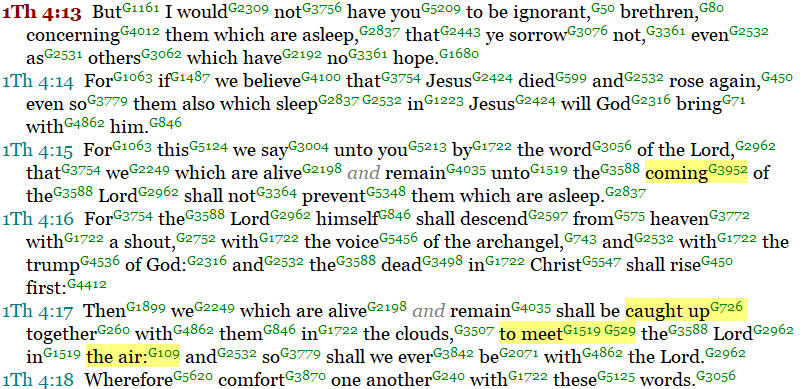
Let’s carefully analyse 1 Thessalonians 4:13-18, the most important passage on the rapture. There are three critical words in this passage:
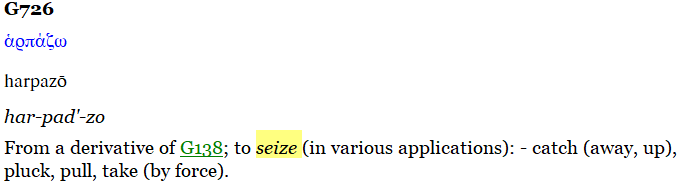
1) HARPAZO Strong's G#726 (“caught up”) - This is the Greek word that many refer to the English word 'rapture' which appears nowhere in scripture.
2) AER Strong's G#109 (“air”), and
3) APANTESIS Strong's G#529 (“meet”).
HARPAZO Strong's G#726 (“caught up”)
The word HARPAZO does not necessarily mean physical removal. It can mean “to seize on, claim for one’s self.” An interesting example of another use of HARPAZO in the New Testament is 2 Corinthians 12:2-6. Paul tells how he was “caught up (HARPAZO) to the third heaven.”
We do not know exactly what happened in this experience; perhaps he was in a trance Acts 10:9; 22:17. But we do know that Paul remained on earth to tell the story.
The term “caught up” in these contexts is closer to what we might say, “I was so caught up in the novel that I saw myself in the story.” In other words it was a figure of speech.
AER Strong's G#109 (“air”)
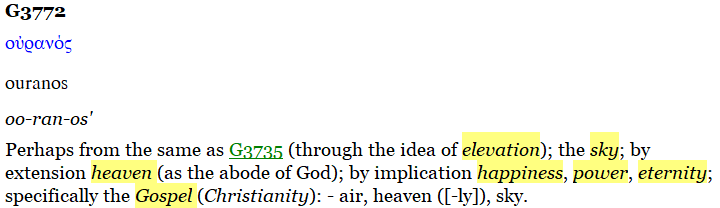
Interestingly, there are two words for “air” in Greek—AER and OURANOS.
OURANOS means the "upper atmosphere", while AER mean the "lower atmosphere", thus the air that we breathe. Paul specifically used AER in this passage. AER may have a spiritual connotation (see Ephesians 2:2). Your feet don’t have to leave the ground to be in the AER.
APANTESIS Strong's G#529 (“meet”)
When Paul said believers would “meet” (APANTESIS) the Lord in the air, this means the exact opposite of what modern rapturists think.
The destination is earth!
The Greek word APANTESIS is found in only two other places in the New Testament. In Acts 28:15, believers from Rome went out to "meet" Paul and escort him back to their city. Similarly, in Matthew 25:1-10, the virgins went out to "meet" the bridegroom and escort him back to the wedding hall. Thus, the image evoked in 1 Thessalonians 4:15-17 is that of believers being spiritually caught up to go out to meet and escort Jesus back to earth to begin his rule on earth.
The idea of believers being physically transported to heaven in a literal rapture is foreign to the text. Its simply NOT what scripture teaches.
Many Christians think that the purpose of the rapture is to escape the Great Tribulation. But Jesus made it very clear that the tribulation was close to them in time in the first century and matched perfectly the events surrounding the destruction of Jerusalem in AD 66-70 Matthew 24; Mark 13; Luke 21. Jesus told his first-century readers that they could escape the tribulation by retreating or fleeing to the mountains!
Many of the disciples did flee to the mountains just as Jesus said, many also disobeyed Jesus and listened to false prophets and instead of fleeing to the mountains went to the temple where they were either killed by the sword or burned alive whole trapped in the temple.
One cannot read 1 Thessalonians 4 and miss the fact that Paul was teaching that the events he was describing would HAPPEN TO HIS CONTEMPORARIES OR THOSE OF THAT TIME. It would make no sense to the Thessalonians for Paul to be describing events that would happen thousands of years later. This timeline would be consistent with Jesus’ numerous “this generation” prophecies, including Matthew 10:23; 16:27-28; 24:29-34; 26:64; etc.
Did Jesus ever say anything about a rapture?
Actually, Jesus prayed against any rapture in the sense of physical removal!
In John 17:15 we see his prayer to the Father, “I do not pray that You should take them out of the world, but that You should keep them from the evil one.”
If Jesus asked for such, would the Father deny his request?
Conclusion
So, what was the “rapture?”
Honouring both the biblical time-texts and careful exegesis of the text, it was Jesus coming “in judgment” in AD 70 to bring the Old Covenant order to a close, to claim believers as his own, and to be with us forever.
Those who were alive and ready for His return were changed into their spiritual bodies "in the twinkling of an eye" as the Apostle Paul wrote about in 1 Corinthians 15:51-57 and in 1 Thessalonians 4:15-8.
This marked the consummation of the New Covenant.
They were expecting it back in the first century and that's exactly when it happened.
Remember the parable of the 10 virgins that Jesus told: five were ready for the Bridegroom and five were not. The five who were not ready knew about the gospel message and, no doubt, this group of people represented by those five virgins in the parable, were instrumental in continuing the propagation of the Gospel message of salvation after the rapture took place.
Futuristic traditional doctrine of the rapture have built it up to be some monumental sensational event that involves millions upon millions across the whole face of the Earth disappearing.
They find it so hard to believe that this has already happened.
Let's consider the fact that the Scripture speaks of a great apostasy. Many had turned away from Jesus and the cross and went back to following the Law. Those believers that were left were scattered, greatly persecuted, and many of them were in hiding.
In other words, it was not necessarily the grand event that futurist teach "it will be".
Make no mistake, it was a grand event for those in the first century that endured until the end. They were changed in a moment in a twinkling of an eye and it was spectacular for them.
John 20:29 Just as Thomas said "Unless I see" I will not believe. This is the same mentality of today's bible believers, "Seeing is believing" right? Yet Jesus said the opposite about his resurrection. We in 2025 believe he rose again on the third day yet none of us were there and none of us saw it with our own eyes yet we believe.
Why? because of the eyewitness accounts of his Apostles and disciples in the first century who wrote the New Testament so that we could have the documented eye witnessed accounts.
However many only chose what they want to believe unfortunately we have to read and apply all that the writers wrote whether or not we like it and whether or not it agrees with your and or not.
Scriptures that were written by the Apostles and disciples of Jesus wrote of his imminent and soon at hand coming. Matthew Chapter 24, Mark Chapter 13 and Luke Chapter 21 are some but not all passages relating to the soon imminent coming in their lifetime (NOT OURS)
This is great news, don’t you think?