The Elements Shall Melt
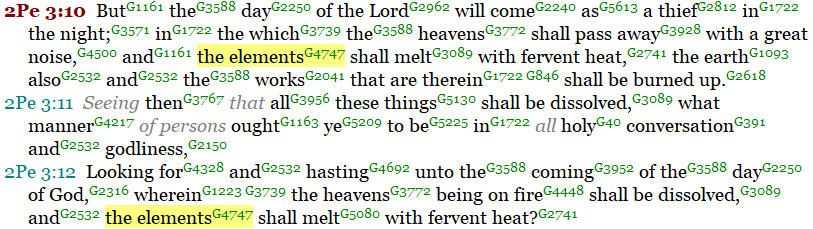
One of the most misunderstood statements in the Bible is that of 2 Peter 3:10;12. “the elements shall melt with fervent heat”. Many modern-day preachers teach and preach that the physical elements of the Earth and the Universe will one day melt and burn up.
Does the Bible really say this?
What exactly does the phrase “the elements shall melt with fervent heat” actually mean?
Let’s take a closer look at how the Bible actually uses the word “elements”.
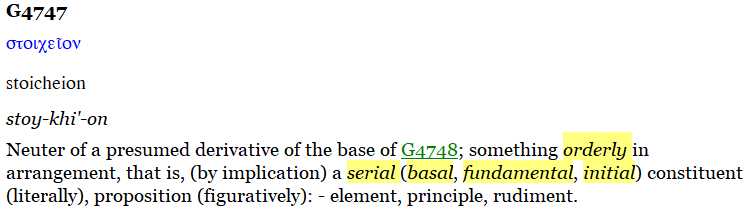
The word “elements” is translated from a Greek word, “stoicheion” Strong's G#4747. This Greek word, “stoicheion” simply means, “elements, principles, or rudiments”.
According to the Thayer’s Greek Lexicon, “stoicheion” refers to the elements of religious training or ceremonial precepts common to the worship of the Jews.
Therefore, these “elements” were the fundamental teachings of the Old Covenant of Israel. This is how the Bible uses this word “elements”.
The word “elements” has nothing to do with the physical creation as many believe today.
“Stoicheion” appears seven times in the New Testament. In Galatians 4:3,9, we can clearly see the context of this Greek word, “stoicheion” or “elements”.
We can plainly see from the context of these two verses, that the Jews were once held in bondage to the “elements” (“stoicheion”) of their world, of their Old Covenant world in which they observed “days, weeks, months, and years of the Law of the Old Covenant”.
Another example is found in Colossians 2:8,20.
Here the Apostle Paul was telling the Assembly in Colossae not to give way to anyone who would influence them to follow philosophy or the tradition of men according to the elements (“stoicheion”) of the world or according to the Old Covenant order.
Paul was reminding the Assembly in Colossae that they were dead in Christ and had no more responsibility to keep the “rudiments” (“stoicheion”) of the old Law.
Clearly, he was not talking about natural elements such as protons, neutrons, and atoms but rather of the teachings or fundamental aspects of the Old Covenant world.
In Hebrews 5:12, the writer is admonishing the Hebrew believers for their lack of growth in understanding the fundamental principles (“stoicheion”) of the oracles of God.
The understanding of these basic rudiments of the Law is what led them to their acceptance of the Gospel message brought to them by Christ. Once again, this Greek word “stoicheion” refers to the “elements” of teaching in the Old Covenant Law NOT the atoms, Earth, wind, fire, or water.
The writer then reminds the Hebrews what the prophets in the Old Testament prophesied about over and over again, …” Behold, the days are coming, says the Lord, when I will make a new covenant with the house of Israel and with the house of Judah.” (Hebrews 8:8, Jeremiah 31:31)
In Hebrews 8:8-13, we read a more detailed description of this New Covenant. The conclusion is stated in Hebrews 8:13 - the Old Covenant was getting ready to vanish away. This meant that all of the “elements”, “rudiments”, and “principles” (“stoicheion”) of their old world was in the process of passing away.
Now that we have established how the Greek word “stoicheion” was used in all of the other 5 passages, let’s read and take a closer look at 2 Peter 3:10-12 in light of what we have established so far.
Here we read the statement “…the elements (“stoicheion”) shall melt with fervent heat.” Just as we read in all of the other previous usages of the Greek word “stoicheion”, this usage is consistent in its meaning:
The fundamental doctrines of the Jewish system contained in the Law of the Old Covenant. Notice here that Peter is not focused on the destruction of this physical world, but on the destruction of the basic fundamentals or “elements” (“stoicheion”) of the Old Covenant system.
These “elements” were the same “Heavens and Earth” of Judaism which were about to pass away in AD 70. Peter affirmed what the Apostle Paul taught in all of his Epistles. (2 Peter 3:15-16)
The destruction of Jerusalem and its Temple is described as the whole Jewish state, the whole frame of their world, the “headquarters” of the “elements” of their religion.
This was dissolved in AD 70. It was all beginning to happen even as Peter was still writing. The Heaven and Earth were already being shaken. (Hebrews 12:25-28)
Peter also reassures the early assembly that, “…. we, according to His promise, look for new Heavens and a new Earth, in which righteousness dwells.” (2 Peter 3:13)
In Isaiah 65:17, Isaiah describes the New Realm that would replace the “elements” of the Mosaic system. Contrary to what the vast majority of preachers are proclaiming today, Peter was NOT predicting the destruction of the material Universe, but rather the passing of the Mosaic system.
The elemental things of Judaism, the priesthood, the Temple, the Temple cultus, the sacrifices, the city, the genealogies were all swept away, destroyed, burned up by the Roman armies in AD 70.
This was the judgment of God against the covenant-breaking Nation of Israel in the year AD 70. It was then that the very heart and soul of that world died. Peter said in 1 Peter 4:7 that the end of all things is at hand.
God said in Isaiah 65:17, that the former Heaven and Earth shall never come into mind. Truly that world with all its “elements” (“stoicheion”) perished. It has been replaced with the New Heaven and the New Earth.
The Greek word “stoicheion” was the elementary education about the Covenant relationship God had with the Nation of Israel. The priesthood was the educators, the Temple was where all the genealogies were kept.
We have the same terminology in our educational system today. The beginning of our education is called Elementary School. This is where we learn all the basics, all the fundamental concepts such as: reading, writing, arithmetic, upon which all of our future education is built.
Galatians 3:24-26 tells us that the Law was a schoolmaster bringing us unto Christ. After faith has come, we are no longer under this schoolmaster; for we are all the children of God by faith in Christ Jesus.
Conclusion
All of these basic “elements” (“stoicheion”) of the Old Covenant were indeed burned up and melted with fervent heat when the Roman armies came and set fire to the Temple and destroyed the City of Jerusalem.
The statement, “the elements shall melt with fervent heat” never referred to the physical planet Earth and its physical elements melting.
The passing away of the “elements” of the Old Covenant ushered in the New Covenant.
Hebrews 10:1 says, “For the law having a shadow of the good things to come….”
Jesus said that He came to fulfill the Law and the Prophets. (Matthew 5:17)
Paul said in Romans 10:4 that Jesus was the end of the law.
Hebrews 10:9 tells us that Jesus took away the first Covenant that He may establish the second Covenant.
Peter said in 1 Peter 4:7 that the end of all things was at hand.
Now, the laws of God are written in our hearts and in our minds. (Hebrews 8:10)
It is only when we obey the Gospel and are born again that we become partakers in this New Heaven and New Earth wherein dwelleth righteousness.
Righteousness means being in a right state with God. (Acts 2:37-39) When we have our sins washed away through baptism in the Name of Jesus and are filled with the Holy Spirit, we too become covenant-connected and are born into the New Heaven and the New Earth and are now in a right state with God.