The Bride of Christ
Throughout the Old and New Testaments of the Bible, we see many references comparing God’s relationship with His people to a marriage, to a husband and wife, and to a bridegroom and bride.
In fact, there are over 75 verses throughout the Bible that describe this intimate relationship that God has always desired to have with His people. God uses this vivid symbolism of the love between a bridegroom and his bride to depict the type of covenant relationship He seeks to have with His people. This relationship is something we all can relate to in some way as we travel through our earthly journey.
From the beginning in the Book of Genesis, we can see how God created a man and woman with whom He desired to have a continual relationship. When Adam and Eve decided to disobey God, they were cast out of their perfect paradise. Since then, God has been in search of a people who would choose to walk with Him throughout this physical life and would ultimately choose to live forever with Him as a part of His covenant people.
We can read in Exodus 19:5-8 how Israel became God’s chosen people at the foot of Mount Sinai when Israel said “Yes” to God’s “vows”. This is when Israel entered into a covenant relationship with their God.
This covenant that God made with Israel was seen as a form of marriage. God refers to himself as a husband unto His people. (Jeremiah 31:32, Isaiah 54:5) Israel started out very devoted to her “husband”. (Jeremiah 2:2), but soon her unfaithfulness became very apparent. (Jeremiah 2:32, 3:20, Jer 7:34, Hosea 9:1)
Israel’s unfaithfulness led to a form of alienation from God. This alienation led to a form of divorce between God and His people Israel. The Scripture actually uses the word “divorce” and “divorcement” to describe this broken relationship. (Isaiah 50:1, Jeremiah 3:8)
The rejection of Israel led to this divorce. In 1 Kings 19:14, we read how the Prophet Elijah summed up the backslidden state of Israel. This total rejection and disobedience of Israel resulted in the Lord making this declaration in 2 Kings 23:27.
In the midst of all Israel’s disobedience and abundant rejection, her loving husband provides a “lifeline”, a “glimmer of hope” to anyone of Israel who desired reconciliation and redemption.
The Bible says that in the “latter days” the children of Israel will return and seek the Lord again. (Hosea 3:5) The Lord makes a very interesting conditional statement in Jeremiah 31:37.
He says, if the heavens can be measured and the depths of the earth uncovered completely, then He would cast off Israel. Modern Science tells us that the heavens are infinite, and the depths of the Earth cannot be discovered. This means that God will never completely cast away His people.
There will always be a divine outstretched hand.
We can read how God was quick to send His prophets to declare a brighter day coming to God’s people. There are many Scriptures that speak of a New Covenant that God will make available to His people. This New Covenant is in sharp contrast to the Old Covenant.
This New Covenant would not be on tables of stone but will be written in the hearts of God’s people. (Jeremiah 31:31-33) The Prophet Joel states that restoration is on the way and that the people of God will never be ashamed. (Joel 2:26-27) Joel goes on to say that this will happen when the Spirit of the Lord is poured out on all flesh. (Joel 2:28-29)
It was on the Day of Pentecost that the prophecy of Joel was fulfilled. (Acts 2:14-18) This was when the Holy Spirit was poured out for the very first time and the Lord put His “law” or also known as His Torah in the inward parts and wrote them on hearts.
The Apostle Peter went on to preach and explain to all the Jews and devout men that had gathered at Jerusalem that day what was happening.
When they heard this explanation, they were pricked in their hearts and asked the question, “What shall we do?” Peter told them exactly what to do to complete their reconciliation back to their God, back to their “husband”. (Acts 2:37-39, 41)
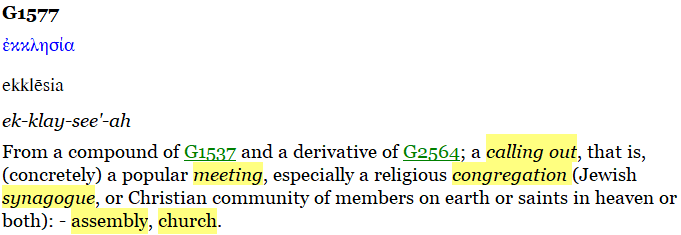
This marked the birth of what people commonly know as the Church or the Ecclesia “the called out ones”.
As discussed, the constant imagery of a marriage relationship between God and His people in the Old Testament. This same imagery of the Bridegroom and Bride is carried on from the Old Testament immediately into the New Testament.
John the Baptist referred to Jesus as “the bridegroom” and himself as the “best man”. (John 3:29) This is one of the first references to the Church as the “bride”.
Jesus also calls himself the bridegroom and the early Church “children of the bridechamber” in Matthew 9:15. This same declaration of Jesus can be found in the other Gospels as well. (Mark 2:19-20, John 3:29) Jesus also told parables with the theme of a wedding and 10 virgins waiting for the coming of their bridegroom. (Matthew 22:1-14, 25:1-13)
In Ephesians 5:23-27 & Ephesians 5:32, we read about the love of Christ for His Church compared to a husband’s love for his wife. The constant comparison in this passage is Jesus Christ being the head of the Church or “Husband” to the Church and the Church being “the wife”.
The love and devotion between a husband and his wife are a direct reflection of the love of Jesus Christ for His Church. The Bible calls it “a great mystery” or “hidden Truth” concerning Christ and the Church.
What love and dedication we see pictured in this marriage imagery!
Upon a closer look at the metaphor of the marital relationship used to describe Christ’s relationship with His Church, we see the Apostle Paul explaining how Jesus loves His Church and is preparing her to be presented to himself without spot or wrinkle. (Ephesians 5:27)
In 2 Corinthians 11:2, Paul describes the “betrothal period” of the Church. In Biblical times, there was a betrothal period during which the bride was separated from the groom until the wedding. The bride’s responsibility during this period was to remain faithful to him.
In Biblical times, the Jewish custom of the betrothal period typically lasted 12 months. This was considered more binding than the modern English period of “engagement”.
In the Hebrew language, this betrothal period or “engagement” was called “kiddushin” which means “sanctification”. After this 12- month betrothal period, a formal wedding would take place.
This whole concept falls in perfect harmony with Paul’s appeal to the Church in Corinth to remain faithful to her Bridegroom to whom she was espoused. Jesus also referred to this period in His parable of the 10 virgins: five were prepared for the coming of the bridegroom and 5 were not prepared.
This whole theme of the bride, or the Church, preparing herself for the actual wedding is depicted perfectly in Revelation 19:7-8. Here we read how the bride has arrayed herself with clean white fine linen which is the righteousness of the saints. Revelation chapters 19 and 20 go on to describe events that happened prior to the New Jerusalem descending down from God.
After all of these things described in Revelation chapters 19 and 20, John saw the new heaven and the new earth; for the former heaven and earth had passed away.
This is when John saw the New Jerusalem coming down from heaven as a Bride adorned for her husband. (Revelation 21:1-2) Then appears to John, one of the 7 angels who sweeps him away in the Spirit and shows him the Bride, who is now the Lamb’s wife.
The angel showed John the Holy Jerusalem which is the New Jerusalem. (Revelation 21:9-10) After all the events of chapter 19 and 20 have transpired, the marriage between the Lamb and His bride is now complete.
Notice in verse 9, the “bride” is now called the “WIFE” of Christ. We know that the Bride of Christ, who is now the wife of Christ, is the Church. Hebrews 12:22-23 affirms this.
Just as the betrothal period in Biblical times was only 12 months, the betrothal period between Jesus Christ and His Church was only a “short” time of preparation and sanctification.
Jesus Christ is now married to His Church. It is erroneous to think that this betrothal period has gone on now for nearly 2,000 years.
Jesus said repeatedly that the first generation to whom He was addressing during His earthly ministry would live to see Him return. (Matthew 16:27-28 24:34, Mark 13:30, Luke 21:32)
We, who have been born again, are ruling and reigning with Jesus Christ in our own lives on this Earth right NOW through the decisions we make in regard to the will and purpose of God in our lives. We are His voice; we are His hands and feet to carry the Gospel to our world.
Conclusion
The metaphor is used throughout the Old Testament often referencing God’s relationship with Israel as a husband to a wife. In the New Testament, the “bride” imagery signifies the Church’s intimate relationship with Christ which is characterized by purity and dedication.
The concept of Christ as the Bridegroom highlights His sacrificial love for the Church just as a groom gives himself fully to the bride. The Prophet Isaiah speaks about this marriage a long time before it actually happened. (Isaiah 62:4-5)
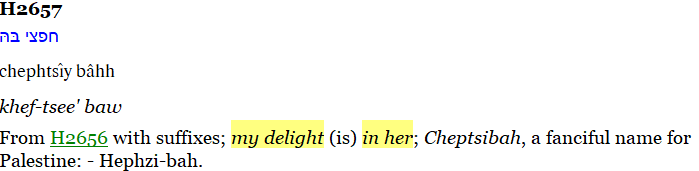
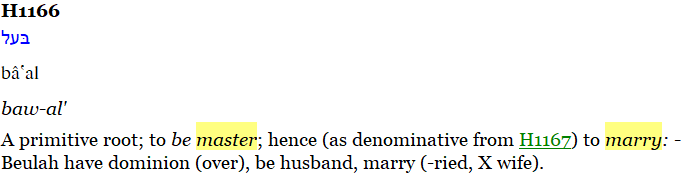
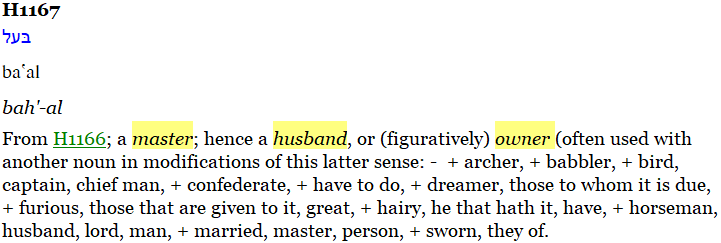
The Hebrew word “Hephzibah” means “my delight is in her”. The Hebrew word “Beulah” or “Ba'al” means “married”. Now God has once again become a Husband to His people, the Church.
Today, the invitation is open. The Spirit and the Bride say, “Come and take the waters of life freely”. (Revelation 22:17) The Spirit of God and the Church together are inviting those lost in their sins to come and be born again and be released from the penalty of sin and death.
Just as a Bride takes on the Name of her husband, so we too must take on the Name of our Lord Jesus Christ through the waters of baptism. If we want to enter into a marriage covenant with the Lord, we must obey from the heart this life-giving Gospel message. (Acts 2:37-39, 41, Romans 6:17)