The Biblical Timetable of The Return of Jesus
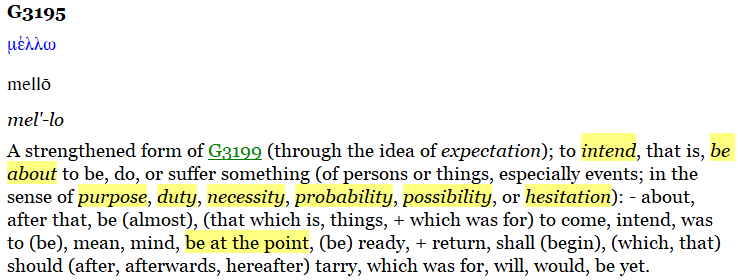
(the Greek word “mello”)
The topic of our Bible Study today is “The Biblical Timetable of the Return of Jesus”. The Bible is actually very clear in its teachings about the timing of the Return of Jesus. Our study today will focus on a Greek word that is very often overlooked. This Greek word “mello” will bring even greater clarity to the Biblical timetable of the Return of Jesus.
This Greek word “mello” appears around 110 times in the New Testament. The Vines Expository Dictionary defines the primary use of the word “mello” as:
“to be, about to be or to be about to occur, or to be about to do”. (p. 1038)
The Thayer’s Greek Lexicon defines “mello” as:
In most translations, the Greek word “mello” Strong's G#3195 is translated as “shall” most of the time. The English word “shall” simply implies a future action with no indication of the timing of this future event; whereas the Greek word “mello” emphasizes the inherent imminency of this action.
Now we will begin to cite some Scriptural examples where the Greek word “mello” is used.
In Luke 7:2, we read about the centurion’s servant who was ready (“mello”) to die.
He was actually at the point of death. His death was imminent, and this is why the Greek word “mello” is used in this passage.
John 4:47, we read about a certain nobleman whose son was at the point (“mello”) of death.
Again, the use of “mello” here stresses the nearness of the death of his son.
In John 6:15, we see the word “mello” used to indicate that the people who saw the miracle of Jesus feeding the 5,000, were about to (“mello”) come and make him a King.
In Acts 3:3, we read that Peter and John were about to (mello”) go into the temple.
Acts 18:14 tells us that Paul was now about to (“mello”) open his mouth to speak at the judgment seat of Gallio.
In Acts 20:3, we read about how Paul was about to (“mello”) to sail into Syria.
Acts 21:27 speaks of the seven days of purification were almost (“mello”) ended when Jews stirred up all the people against Paul.
In Acts 27:33, we see another similar usage of “mello”; “While the day was coming….” (“mello”)
In Matthew 2:13, we see very specific and immediate instructions given to Mary and Joseph, “…. Arise, and take the young child and his mother, and flee into Egypt… for Herod will seek (“mello”) the young child to destroy him”.
In Luke 10:1 we find Jesus sending the disciples out two by two into every city where He himself would come (“mello”) shortly.
In John 6:5-6, we see Jesus setting the stage for His miracle of the feeding of the 5,000. He questioned Philip “….to prove him: for he himself knew what he would do.”(“mello”) “Mello” was used in this passage to indicate that shortly Jesus was going to feed the 5,000.
In Luke 19:4, we see Zacchaeus climbing up into the sycamore tree to see Jesus because he knew that he was to pass that way (“mello”) shortly.
In Matthew 20:22, we see Jesus at the Last Supper saying, “…. are ye able to drink of the cup that I shall (“mello”) drink of…..”
The word “mello” was used here because His crucifixion was imminent, it was very near.
In Acts 16:27, we read about the keeper of the prison when he noticed the prison doors open, “…. he drew out his sword and would have killed (“mello”) himself supposing that the prisoners had been fled.”
He was very close to killing himself when Paul’s voice stopped him.
There are many more Scriptural examples very similar to the ones cited where the Greek word “mello” is used over and over again to denote something that was about to take place or the nearness of an event.
The examples that we have already cited have proven this meaning.
This same Greek word “mello” is also used in several Scriptures that reference the coming judgment, the resurrection and the return of Jesus Christ.
Let’s look at some of these references.
Our first two references are seen at the beginning of the Olivet Discourse in Mark. 13:4 and in Luke 21:7.
In both of these references, the disciples were asking Jesus what shall be the sign when all these things shall (“mello”) be fulfilled.
This is very important because the use of the word “mello” in these verses proves that when all of the signs were present, the coming of Jesus to judge the wicked, to resurrect the dead, and to reward the righteous was imminent.
As a matter of fact, that very generation who were asking Jesus this question that day, Jesus proclaimed that they would still be alive to see this. (Mark 13:30, Luke 21:32)
In Luke 21:36, Jesus stressed the imminency of His coming once again when He said “…. that ye may be accounted worthy to escape all these things that shall (“mello”) come to pass….”
The use of “mello” here by Jesus stresses that the time was very short.
Jesus makes a strong time statement in Matthew 16:27-28. “For the Son of man shall (“mello”) come in the glory of his Father…. he shall reward every man according to his works….”
Then He clearly states, “…. there be some standing here, which shall not taste of death, till they see the Son of man coming in his kingdom.”
This is a clear reference to what many Christians call “the second coming” or “the rapture”. This use of the Greek word “mello” further substantiates a first century return.
The word “mello” used here still means “something that is about to happen”. Jesus said it Himself that some of them would actually see this happen.
Another powerful statement of imminence is found in Hebrews 13:14. “For we have no continuing city, but we seek one (“mello”) to come.”
Their “continuing city”, their New Jerusalem was about to come. (“mello”) It was very near. In Revelation 1:19, we see the glorified Jesus telling John to write the things which he was seeing and to write the things “which shall (‘mello’) be hereafter”.
This means that everything recorded in the Book of Revelation were things that were SHORTLY (“mello”) going to happen.
In Acts 24:15, Paul proclaimed to Felix, “…. that there shall be (“mello”) a resurrection of the dead, both of the just and unjust.”
The use of the word “mello” strongly stresses the nearness of the resurrection. The strong imminency and urgency of Paul’s statements even frightened Felix. (Acts. 24:25)
Another statement of Paul about this urgency can be found in 2 Timothy 4:1. “…. who shall (“mello”) judge the quick and the dead at his appearing and his kingdom.”
The use of “mello” here clearly indicates that the judgment, the resurrection, his coming, and the arrival of His Kingdom (the New Covenant) are all about to take place.
The word “mello” is also used in Hebrews 2:5 and in 6:5 denoting the nearness of the “world to come”.
The coming of the Kingdom of God was imminent; it was very near. (“mello”) In Acts 17:31, we read again how Paul stated that the judgment of God was near; He was about to judge. (“mello”)
Jesus states again in Revelation 3:10 the imminency of the coming tribulation. Here Jesus says “…. I will also keep thee from the hour of temptation which shall (“mello”) come upon all the world…” (their world)
Another reference to the nearness of the “world to come”; Ephesians 1:21, “…. not only in this world, but also in that which is (“mello”) to come.”
Conclusion
The use of the Greek word “mello” indicates something is “about to be” or “about to occur”. This use of “mello” can be undeniably seen in many Scriptures that we cited in the first section of our study.
However, when it comes to passages of scriptures that use the word “mello” in reference to the return of Jesus and other end time events, many Christians become reluctant to apply this same urgent time frame that the word “mello” demands.
This is because most Christians have been taught and believe that these events have been postponed for some reason and are way off in our distant future.
To believe that Jesus has not returned yet to accomplish everything He said He would, is to completely ignore the clear Biblical timetable.
To project His Return into our future is to completely ignore the Greek word “mello” as it is used in all of the Scriptures. The imminency stated by the Scripture which is even more accentuated by the use of the Greek word “mello” completely obliterates a 2,000-year delay in His coming.
Not only can we see Jesus and the Apostles teaching about the imminence of these “end time” events, but the Greek use of the word “mello” is another undeniable proof that Jesus did return which brought an end to the Old Covenant and ushered in the New Covenant.
The Scriptures involving this word, “mello” and the coming of Jesus Christ imply the imminency of His coming and therefore further substantiate a first century return.