How to Acquire Forgiveness in the Eyes of God
I think we all know and agree that words have meaning. Yes, means yes and no means no. A word means what its definition is and not something else.
With that in mind, we are going to take a look at a few words that impact Christians and are sometimes misunderstood and misapplied. This can cause a problem in our belief system. This is especially true when it comes to words dealing with our salvation. The words that we are going to focus on are: “repent” or “repentance”, “forgive” or “forgiveness”, and “remit” or “remission”.
Some mistakenly believe that the words repentance, forgiveness, and remission mean the same thing and are interchangeable. This is partially correct but not totally.
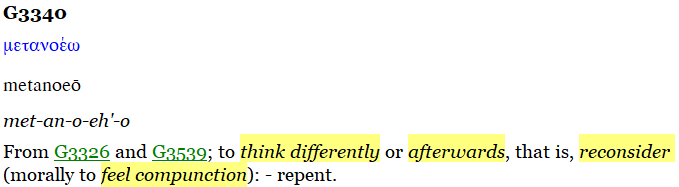
The Greek word for repentance is different than the Greek word for forgiveness and remission which are the same. The Greek word for repentance is “metanoeo” Strong's G#3340.
“Metanoeo” means: a change of mind, reversal of one’s decision, to feel guilt and sorrow for one’s sins, to think differently, and to reconsider. This occurs as a response to hearing the Word of God and through the message of the Gospel. Repentance is translated from the Greek word “metanoeo” 58 times in the New Testament.
Adam was made in the image of God. Genesis 1:27 After failing God and committing sin, sin and death passed upon all men. Romans 5:12 We are all born in sin and have the fleshly carnal fallen nature of Adam.
We are in need of a Saviour. In repentance, we acknowledge our sin and act upon that knowledge with a desire to turn from our sinful life. We experience a Godly sorrow.
We were born with a nature that was walking away from God. Repentance or “metanoeo” is when we change our minds and begin to walk toward God and toward His calling.
Repentance is NOT forgiveness of sin NOR remission of sins; it only puts us in a position to receive forgiveness or remission of sins.
John the Baptist is the first one in the New Testament to come on the scene preaching repentance. Matthew 3:2, Mark 1:15, Luke 3:8 John the Baptist was the one sent by God to prepare the hearts of the people for their coming Messiah.
His message was an urgent one for his hearers to “repent” metanoeo or “to have a change of mind and begin to walk toward God and toward the calling of God”. metanoeo
Jesus began His earthly ministry by echoing this same message saying “Repent, for the kingdom of heaven is at hand.” Matthew 4:17, Luke 5:31-32 Jesus sent the disciples out two by two to preach repentance in every place they went. Mark 6:12
The disciples continued to preach “repentance” throughout the book of Acts and throughout the epistles. Acts 17:30, 2 Corinthians 7:10 The Apostle Paul tells King Agrippa how he was obedient to the heavenly vision that he received on the road to Damascus and preached repentance metanoeo and beckoned all of his hearers to turn to God. Acts 26:20
Some of the other more prominent New Testament Scriptures where the Greek word “metanoeo” is used are: Luke 3:8, 13:3,5 16:30 17:3,4 24:47, Acts 2:38-39, 5:31, 8:22, Romans 2:4, 2 Timothy 2:25, Hebrews 6:1,6 2 Peter 3:9, Revelation 2:22
The Greek word for forgiveness and remission is “aphesis” Strong's G#859. The same word is interchangeable throughout the Scriptures with the English words forgiveness and remission.
This Greek word “aphesis” means: to release from bondage or imprisonment; dismissal; pardon from sin; letting them go as if they had never been committed; to set free; send away; remission of the penalty; to release from the obligation of debt.
“Aphesis” is used 17 times in the New Testament: 9 times it is translated “remission”; 6 times it is translated “forgiveness”; 1 time it is translated “deliverance”; and 1 time it is translated “liberty”.
The mistake some make is not understanding the true meaning of these words. Many think that forgiveness is given when one repents. Many also think that forgiveness of sin is different from the remission of sin. This is simply not true according to the Scriptures.
First of all, forgiveness and remission come from the same Greek word, “aphesis”; therefore, they mean the same thing.
Second, we must realize that a person cannot receive forgiveness or remission of sins, “aphesis”, without first experiencing repentance “metanoeo”. True repentance must always come first before one can receive forgiveness. Mark 16:16, Acts 2:38
.
The act of repentance alone does not bring forgiveness or remission of sins. By saying this, we are focusing on an individual who is first coming to God and not on someone who has been born again of the water and of the Spirit.
The person who has been born again of water and Spirit has a relationship avenue to forgiveness that the first-time sinner does not have yet.
This is because the Blood of Jesus has already been applied to their lives through Water Baptism in the Name of Jesus. A person who has repented only and not been baptized in the Name of Jesus Christ has never had the blood of Jesus applied to their life, therefore; have not received forgiveness or remission of their sins. aphesis
As we look at the first Gospel message preached by the Apostle Peter on the Day of Pentecost, we find the use of both words and how they apply to salvation. Acts 2:38
Peter told the crowd that they were the ones who rejected their Messiah and hung Him on the cross. If anyone needed to be forgiven, it was them. The Scripture says that they were pricked in their hearts by Peter’s message that day. Acts 2:37 They had a change of mind with Godly sorrow and asked Peter what they should do to remove the guilt and get rid of their sins.
Peter’s reply was to repent, “metanoeo”; stop walking away from Jesus and turn from your sins.
He also said for them to be baptized in the Name of Jesus Christ, the one who died for you, for the remission or forgiveness of your sins. “aphesis” Notice the order: repent first, “metanoeo” then receive remission or forgiveness of sin, “aphesis” upon being baptized in the Name of Jesus. Acts 2:38
He told them what to do and also admonished them to save themselves from this untoward generation, the generation that was walking away from God. Acts 2:40
There were about 3,000 people who gladly received the Word of Truth that day and were baptized for the remission aphesis of their sins and were added to the Kingdom of God. Acts 2:41
Another Scripture that uses both Greek words can be found in Luke 24:47. Here, it is Jesus who makes a clear distinction between “repentance” metanoeo and “remission” aphesis.
Jesus did not just say preach “repentance” only because repentance alone was not enough; but “repentance” first than the “remission” of sins.
This is exactly what the Apostle Peter preached on the Day of Pentecost. The Apostle Paul also makes a clear distinction in Acts 22:16. After being struck down and blinded on his way to persecute the Church in Damascus, surely Saul had Godly sorrow, and his heart was full of repentance. Notice how Saul still had to “arise and be baptized” to actually “wash away his sins”. This is when Paul received true forgiveness in the eyes of God.
Some other more prominent Scriptures where the Greek word “aphesis” is used are: Matthew 26:28, Mark 3:29, Luke 1:77, 3:3, 5:31, 10:43, 26:18, Colossians 1:14, Ephesians 1:7, Hebrews 9:22, 10:18
Conclusion
We can clearly see that the word for repentance is translated from the Greek word “metanoeo”. The word for forgiveness and remission are translated from the same Greek word “aphesis”. This means that forgiveness initially comes when the person who has repented is baptized in the Name of Jesus for the remission or forgiveness of their sin.
Forgiveness does not come when a person repents.
Repentance only puts us in a position to receive forgiveness or remission of sin through Water Baptism in the Name of Jesus. After we repent, it is through the waters of baptism in the Name of Jesus Christ that we acquire true forgiveness in the eyes of God.
With regard to a person who has been born again; this person has the avenue of forgiveness from sin by repenting and confessing those sins to God. This is because the Precious Blood of Jesus has already been applied to their lives through Baptism.
A born-again believer has already received the Blood Covering. 1 John 1:7-9 If one continues to walk in the light as He is in the light and has a relationship with Him and then commits a sin; one can confess his sin and He is faithful and just to forgive that sin and to cleanse him from all unrighteousness.
This is not the same for a first-time believer who comes to Christ. The first-time believer must first be baptized into Christ before this avenue is made available to him.
After being born again of the water and of the Spirit, this avenue of cleansing is then made available to this believer because he now has been born into the Kingdom of God. He now has become a partaker of the New Covenant.