A Closer Look at the Word "World"
In our modern-day English language, we have many different synonyms for the word “world”.
Some of these synonyms refer to the literal meaning of the word, such as: planet, Earth, globe, universe, and cosmos.
Other synonyms refer to a contextual meaning such as: society, secular interests, temporal concerns, and earthly interests.
In order to get the proper meaning intended for the word “world” as used in a sentence, one must consider the context surrounding the word. In other words, the flow of the words and thoughts surrounding the word “world” will give us a clear understanding as to what aspect of the word is intended.
We must apply this same principle when we read and study the Word of God.
Just as in the English language of today, the Koine Greek language, which is the language of the New Testament, we find many synonyms for the word “world”.
Just as in the English language, we can always arrive at an accurate meaning of this word by giving careful attention to the context in which it is used.
We will begin this study by taking a brief look at three synonyms of the word “world” and how they are used in the Koine Greek.
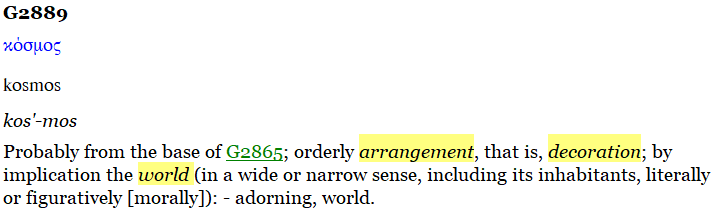
“Kosmos” G#2889
The first Koine Greek word we will be looking at which is translated as the English word “world” is “kosmos”. When “kosmos” is used, it refers to the orderly arrangement of a system often referring to the whole world or the Universe. We can derive the true meaning of “kosmos” from the context in which it is used. We derive our English word “cosmos” directly from this Greek word.
One Scriptural example of the use of “kosmos” can be found in Acts 17:24. One can easily tell from the context of the word “world” as it is used here refers to the Universe.
Another example is in 1 Corinthians 8:4. In this verse, we see the word “world” refers to the whole world because He is God of the whole Universe.
Another example can be found in John 21:25. Here John boldly proclaims that the “kosmos” or “world” or “Universe” itself could not contain the books that could be written about all the acts of Jesus because He is God manifest in the flesh.
There are many more verses where the word “kosmos” is translated into the English word “world”. From these few examples cited we can get a feel for how the Greek word “kosmos” is used in the Bible.
Oikoumene G#3625
The second Greek word we will look at is “oikoumene”. This Greek word refers to the land, the world kingdoms, the whole inhabited earth. A verse that illustrates the usage of this Greek word is in Acts 17:6.
In this verse, his disciples were being accursed of turning the “world” upside down with their doctrine. This context here does not denote that they were turning the whole Universe upside down, but rather the Roman Empire that was the predominant Kingdom and power in their day.
Another clear example of the usage of “oikoumene” can be found in Acts 24:5. Again, here the word “world” refers to the Roman Empire or their inhabited “world”.
In Romans 10:18, we find the Gospel being heard “unto the ends of the world”. Truly they were going throughout the whole known and inhabited world of the Roman Empire with this Gospel message.
From these examples, we can get an understanding what the Greek word “oikoumene” denotes.
Simply put, the Greek word “aion” means “age”.
“Aion” is used more than 40 times in the New Testament. It NEVER means this physical planet or Universe. As we already pointed out, the Greek language has other words to denote the physical planet we call Earth.
Let’s begin to take a closer look at just how this Greek word is used.
The New Testament writers often refer to their “world” as “this age”.
We see an example of this in Matthew 13:22. In this parable, the cares of “this age” choked out the seed of the word.
In Galatians 1:4, we read about the deliverance of Jesus from their present “world” or “evil age” in which they lived. Paul admonishes Timothy about the riches and allurements of “the present world” or “age” in which they lived. 1 Timothy 6:17, 2 Timothy 4:10, Titus 2:12
In all of these Scriptural examples, the Greek word “aion” refers to their present “world” or “age” in which they lived.
Jesus also taught about a future “aion” or “age” that was coming very soon.
Another “world” or “age” was coming very shortly in their future in which eternal life would exist. Luke 20:35, 18:30, Mark 10:30
The New Testament writers also wrote often about the new “age” or “world” that was about to come. Ephesians 1:21, Hebrews 6:5
The Apostle Paul even went so far as to say that the end of the “world” (“aion”) or “age” had come upon them in the first century. 1 Corinthians 10:11
He did NOT mean the end of the planet, but rather the end of an “age”. This is why the Greek word “aion” is used.
Jesus said in Matthew 13:39, that the harvest will happen at the end of the “world” (“aion”) or the end of the “age”.
When the disciples asked Jesus, “….what shall be the sign of thy coming and of the end of the world?”, the word “world” here is translated from the Greek word “aion” or “age”. Matthew 24:3
This context tells us clearly that they were asking Jesus what the signs of His coming would be and the end of their “world”, not the end of the planet Earth. Jesus goes on to give the complete list of all the end time events associated with the end of their “Old Covenant world”, or “their Old Covenant age”.
The writer of the Book of Hebrews sums it all up in Hebrews 9:26.
In this verse, the first word “world” comes from the Greek word “kosmos” or the foundation of the orderly system of the Covenantal Law given at Mt Sinai.
The second word “world” is translated from the Greek word “aion” or “age”.
Jesus put away sin once and for all at Calvary at the “end of the world” or “age”.
This verse is telling us that Jesus died on the cross at the “end of the world” or better translated as end of the “age”.
Notice that the physical world did not end when Jesus died at Calvary, but the Old Covenant World was getting ready to vanish away. Hebrews 8:13
This is why the Greek word “aion” is used in Hebrews 9:26.
Conclusion
Understanding all of the different usages of the word “world” in their proper context is truly a “game changer”.
Many preachers today teach and preach the end of the world is coming so soon and Jesus is about to return. They take these very same scriptures that we have read in this lesson and take them totally out of context.
When Jesus was asked in Matthew 24 the question what shall be the sign of His coming and of the end of the world, He gave a very clear and concise answer.
The question is: “Why are so many preachers and teachers misapplying these same Scriptures today?”
We have proved through this study on the use and context of the Greek words “kosmos”, “oikoumene” and “aion” that the only world that was getting ready to end in the first century was the “world” or “age” (“aion”) of the Old Covenant.
We are now living in that “future” “age”, “aion” or world that Jesus taught us about. This world has no end. Ephesians 3:21